Why B2B SaaS SEO agency comparisons are structurally biased §
Search b2b saas seo agency comparison in July 2026 and something awkward happens. Nearly every page ranking on the first two pages of results was written by one of the agencies on the list. The Grow and Convert listicle currently near the top for adjacent queries places Grow and Convert at #1 — in Grow and Convert's own voice, with third-person summaries of the other agencies (retrieved 2026-07-20). The Animalz post on AEO and GEO agencies does the same thing for Animalz (retrieved 2026-07-20). This is not a hit piece on either. It is the format the SERP rewards. If you rank a comparison page for your own category, you tend to rank yourself first.
Note that I work for Meridian. Therefore in principle the below is me talking about Meridian, and the same is true for everything I write. So the terms of the bargain are: apply the same dimensions to every agency, refer to each comparative claim with a source to agency page and the date on which I made my claim (2026-07-20 everywhere), and call out cases where Meridian isn't the optimal choice. If I slip up on any of that, this article will merit the same consideration as all the other "agency-written" listicles that are actually "written by consultants who sell you their services". Read on at your own risk.
Nearly every page ranking for this category was written by an agency that ranks itself #1. The only defense is method: score every agency on the same dimensions, attach a source and a retrieval date to each comparative claim, and name the cases where Meridian is the wrong pick. If any of those slip, treat this like every other agency-written listicle.
The four agencies are more distinct in their positioning. Animalz is more editorial thought leadership, named-byline authority. Skale is more AI search-first organic growth for scaling SaaS. Grow and Convert is more BOFU-first Pain Point SEO, and a Prioritized GEO layer on top. Meridian is more technical B2B production with AI search as default and published month-to-month pricing. Which one is on your shortlist? Depends on decisions you have not made. This article is to help you make them.
Decision criteria for picking a B2B SaaS SEO partner §
Before I compare anyone, let me explain the seven dimensions of the formula that I apply to every agency and every comparison.
Pricing posture and contract length. Is pricing published or gated? Is the contract month-to-month, quarterly, or annual? Cancellation terms often matter more than the sticker.
Who actually writes the content. In-house editors, product copywriters (many agencies have these), SME interviewers (freelancers), or a mix. All agencies puff their writer quality, but only by looking at the process can you know how.
Scope of the engagement. Strategy only, content only, or end-to-end. Some agencies expect an in-house lead. Others run the whole engine.
Subject-matter accuracy in technical categories. SaaS is a broad label. A developer-tools buyer, a security engineer, and a fintech analyst read very different prose. Ask how the agency handles categories where a wrong sentence gets caught by a technical reader.
AI-search and GEO approach. Every agency now claims some AI-search capability. It's worth determining whether they have a real methodology (like entity mapping, LLM citation research, restructured content architecture) or if they're just adding a checklist item to their services page. Animalz makes this point at the start of their own AEO list article: "every SEO agency has added AEO to their services page" (retrieved 2026-07-20).
Reporting metrics. Does the agency report pipeline, SQL, and revenue, or rankings and traffic? Both are true, they just answer different questions.
Best-fit company stage. Early-stage engine build, growth-stage BOFU pipeline, and enterprise thought leadership are different jobs with different agency shapes.
These are the dimensions on which the rest of the article will rely. If something seems out of scope, look for one of these.
Animalz — profile §
Positioning. Managed content marketing with a service line: the AEO service line for Animalz, per the Animalz AEO and GEO agencies post (retrieved 2026-07-20). Their published methodology includes audits of ChatGPT, Claude, and Google AI Overview, entity maps of which LLMs trust which sources, and prioritized restructuring plans for summaries, FAQs, comparison tables, and schema markup.
Who writes. In-house editorial team conducting SME interviews. Animalz blog index has a list of named authors, which includes Tim Metz, Ryan Law, Nathan Wahl, Sara Coggin, Ty Magnin, Jimmy Daly, and so on (retrieved 2026-07-20). Most recently, Sara Coggin wrote "7k to 200k Monthly Visits — How Amplitude Built a Content Engine That Scaled From Seed to IPO."
Pricing. Not publicly listed as of 2026-07-20. No pricing page is exposed on their public marketing surface.
Best-fit stage. Established brands who need editorial thought leadership and are willing to pay for it. Amplitude-shaped: post-Series B, with a real in-house content team, budget and category, where a well written essay from a named editor will move the needle.
Honest read. Animalz is the strongest editorial writing shop of the four for scaled brand storytelling. If you want a content team that reads books and can write a Ryan Law post, pick them. Where I would push back: for very early stage SaaS or deeply technical product categories (think containers, GPU orchestration, kernel-level security), the mechanism in place (SME interviews turned into editorial essays) assumes you have SMEs with time to interview. If your SMEs are three engineers who are shipping the product, that budget might get more value from a technical writer.
Skale — profile §
Positioning. AI-search-first organic growth for SaaS. The Skale SaaS SEO guide by Jake Stainer treats all organic and AI search as one and the same, and assumes a GTM-motion → SEO/GEO focus split. Self-service, SMB, and enterprise motions are aligned to each play. (Retrieved 2026-07-20) There is a strong emphasis on the reporting on this, which focuses squarely on the pipeline and MRR rather than rankings.
Who writes. A blended model that reads as a marketing team doing their own marketing. This mirrors the Skale SaaS guide that describes Skale as a "plug-in organic-growth function", not a single-editorial-voice house. (Skale SaaS guide, retrieved 2026-07-20.) Skale reads more like a growth-content function you plug in than a magazine you subscribe to.
Pricing. Not even available as of July 2026. They have "Case studies & client testimonials", but no "pricing page".
Best-fit stage. Growth-stage SaaS with an in-house marketing lead who wants an outsourced execution engine that is SQL/revenue driven. Companies that only ask the question "How many demos did content generate this quarter?"
Honest read. Skale's public author history (as per their SaaS SEO guide and Jake Stainer's stated engagement history on Typeform, Pitch, Appcues, HotJar, G2, Recruitee, and TravelPerk) is the clearest SaaS-specific signal of the four. If your only KPI is pipeline and you already have a marketing lead, they're on your shortlist. Less obvious: if you want a single editorial voice, or a content lead who thinks about your brand every day for the next five years, a blended-execution model can feel utilitarian.
Quick disambiguation (you may find the words 'Meridian' in Skale's case studies below): there's another Skale product, Meridian, that has a public case study index. None of the numbers in that story are us.
Grow and Convert — profile §
Positioning. Pain Point SEO and Prioritized GEO, Naman Nepal. Retrieved 2026-07-20. The author says that most B2B SaaS SEO services have historically focused on optimizing site speed, fixing technical issues, and building domain authority. They believe that this is helpful, but not enough to move MQLs/SQLs to SQLs, or increase MRR, without a buying-intent keyword strategy. Prioritized GEO would add AI-search on top of the BOFU-first approach.
Who writes. In-house product copywriters, who go through a structured interview process and writing exercise. Their process is one of the clearest writer-training mechanisms in the industry. (Per the Grow and Convert listicle, retrieved 2026-07-20.)
Pricing. The Grow and Convert listicle writes pricing upfront (as of 2026-07-20): $10,000/month or $9,000/month (discounted for annual commitment), plus $2,000/month for citation-outreach for their GEO work. They are one of two agencies in this review that have published pricing.Grow and Convert's published pricing (retrieved 2026-07-20): $10,000/month, or $9,000/month on an annual commitment, plus $2,000/month for citation-outreach on the GEO layer.
Best-fit stage. SaaS companies that are past product-market fit and need to focus on fewer, deeper BOFU posts. They can handle higher-effort content creation. If a keyword set that you target clearly converts, Grow and Convert is a great shortlist pick.
Honest read. Grow and Convert has the strongest single opinion of the four. That is a feature: the whole model is built around the belief that bottom-of-funnel keywords with buying intent are better than traffic-first strategies. It is also a limit — if you are building an editorial engine for authority, the "we publish a thoughtful essay every week" motion, they are not the shape you want. They also cite, in the Grow and Convert listicle, a 72% top-page and 77% top-three correlation between Google top rankings and LLM mentions (retrieved 2026-07-20). Read that as their published correlation figure, not an independent industry benchmark.
Meridian — profile §
Positioning. Meridian is a managed SEO partner for technical B2B — SaaS, AI, DevTools, cybersecurity, infrastructure, data platforms (retrieved 2026-07-20). SEO strategy, AI-search optimization, and expert-grade production, end to end. AI-search is default across fourteen named discovery surfaces: Google, ChatGPT, Claude, Perplexity, Bing, Gemini, Reddit, Microsoft Copilot, Meta AI, LinkedIn, Yahoo, Brave Search, DuckDuckGo, and DeepSeek — bundled into Growth and Authority tier pricing, not sold as a standalone add-on.
Who writes. Specialist writers may support production, but strategy, editorial standards and final quality review (per Meridian's about page, accessed 2026-07-20) are close to Vladislav Stepanov, the founder. The intended reader experience is that every deliverable is reviewed by someone who has shipped regulated software (IL5 and NIST 800-171/172 background) and can review a technical wrong sentence before it goes out.
Pricing. Three tiers, no annual commitment, found on the homepage as of 2026-07-20: Starter: $1,500/month for 4 articles. Growth: $3,500/month for 8 articles, plus AI Overview and LLM optimization. Authority: $5,500/month for 12 articles, plus SME-led authority content and a dedicated strategy owner.
Best-fit stage. Post-Series-A technical B2B SaaS with a real product and a real category. Meridian's reported client results (abv.dev at $378k pipeline in two months and +71% non-branded clicks, and a DevOps Series B client at $640k pipeline in 12 months and +86% buying-intent traffic) are in this band. (These are Meridian's own reported numbers, not an independent audit.)
Honest read (and this is the part the format usually skips). Meridian is not the right answer for consumer or B2C content, ecommerce SEO, local SEO, or generic professional-services SEO. If what you need is just a keyword-list-only deliverable with no editorial layer, the model does not fit. And if your only decision variable is price, the Starter tier is a competitive entry point (though there are freelancers who can do part of the job cheaper). The competitive frame Meridian actually wins on is: cheap-and-shallow (generic agencies) versus deep-but-inconsistent (in-house without dedicated time) versus deep-and-dependable, at published pricing.
Side-by-side: pricing, contracts, deliverables §
Each cell has a source URL and date. No agency makes a claim, so cells reflect the absence of such a claim.
| Dimension | Animalz | Skale | Grow and Convert | Meridian |
|---|---|---|---|---|
| Public pricing | Not listed as of 2026-07-20 | Not listed as of 2026-07-20 | Yes — $10K/mo, or $9K/mo annual, per Grow and Convert (retrieved 2026-07-20) | Yes — $1,500 / $3,500 / $5,500 per seekmeridian.com (retrieved 2026-07-20) |
| Contract length | Not publicly stated | Not publicly stated | Monthly or annual (annual is the discount tier) | Month-to-month per seekmeridian.com (retrieved 2026-07-20) |
| Content cadence | Editorial cadence (recent Amplitude case study by Sara Coggin on the Animalz blog, retrieved 2026-07-20) | Organic growth content production | Fewer, deeper BOFU posts plus a GEO layer | 4 / 8 / 12 articles per month by tier |
| AI-search service | AEO audits, entity maps, restructuring plan per Animalz (retrieved 2026-07-20) | SEO and AI-search as one system per Skale guide (retrieved 2026-07-20) | Prioritized GEO layer plus a $2K citation-outreach add-on per Grow and Convert (retrieved 2026-07-20) | AI Overview + LLM optimization bundled into Growth and Authority tiers per seekmeridian.com (retrieved 2026-07-20) |
| Who writes | In-house editors with SME interviews | Blended extension of client marketing | In-house product copywriters, trained | Specialist writers with founder-level review per Meridian about (retrieved 2026-07-20) |
| Primary metric | Editorial authority and traffic | Pipeline, SQL, MRR | BOFU conversion and pipeline | Non-branded organic pipeline (per Meridian's reported cases) |
First, pricing is not a Meridian marketing ploy; it's a reflection of the current state of the market. Only Meridian and Grow and Convert publish pricing tables. If Animalz or Skale decided tomorrow to start offering a service and price it, this table changes. And finally, the metric row is where most marketing copy gets hazy. If there's a conflict between what's in the metric row and what the agency says about the metric and reporting cadence, trust the reporting cadence.
Side-by-side: who actually writes the content §
Every agency can talk about their writers. Only ones that specify the process can let you know.
Animalz has in-house editorial staff do SME interviews and then publish the reasoning they gleaned from the interview as an editorial essay, under the SME's byline. It works well for SME interviews when the SME has time, and for longer form opinions, such as category essays.
Skale. The same is true for writers, who are considered an extension of a client's marketing team. To demonstrate this, Skale has a guide to SaaS SEO by Jake Stainer (retrieved July 2026), and Jake has written for Typeform, Pitch, Appcues, HotJar, G2, Recruitee, and TravelPerk. This model is more like an outsourced content team than a magazine with a named editor for each issue.
Grow and Convert has in-house product copywriters who are trained in interview and writing practices, per their own listicle (retrieved 2026-07-20). The implications for the reader are fewer writers, but each writer is trained in the model and writing practices, and each is writing in the G&C editorial voice.
Meridian vets specialist writers for technical accuracy and performs a first review by a Meridian founder before a piece is published. As it explains on its about page (the strategy and editorial standards sections and the section on final quality review are maintained by Vladislav Stepanov; accessed 2026-07-20), the Meridian reader can assume that if a technical reader can spot something wrong, someone in the Meridian team would have spotted it before.
None of these are necessarily better than the other. They all serve different jobs. If you are writing an article that is more like a Ryan Law type essay, use Animalz. If you have a pipeline and you need the organic engine to drive things, use Skale. If you want to write a BOFU conversion post that could rank and convert, use Grow and Convert. If you are a technical B2B writer and want to sound like you know the product, Meridian.
Side-by-side: AI search and generative engine optimization §
This is the live 2026 differentiator — and where the format most tempts agencies into overclaiming.
The first clue is in the AEO listicle, by Animalz: "every SEO agency has added AEO to their services page" (retrieved 2026-07-20). First Page Sage market themselves as an "SEO + GEO agency" (retrieved 2026-07-20). Foundation SEO, also present in our sample data, list as one of their services "Research services: Query Fan Out Research, LLM Visibility Research, LLM Citation Research" (retrieved 2026-07-20). And Skale see themselves as doing a combined SEO and AI-search: SEO and AI-search are one connected organic system (retrieved 2026-07-20). In short, AI-search is no longer a differentiator; it's table stakes. What matters is how they do it.
Animalz details an AEO approach to audit ChatGPT, Claude, and Google AI Overview, plus entity maps of which LLMs trust what sources, and a prioritized restructuring plan for summaries, FAQs, comparison tables, and schema. Retrieved 2026-07-20. This is not a "checklist to services page" approach, but rather a methodology.
Skale treats AI-search as a part of SEO. The guide divides GTM motions into self-service and enterprise SaaS and describes how the AI-search plays are different for each (retrieved 2026-07-20). It's not so much a question of how many links to websites as it is how the AI-search play fits the GTM motion.
Grow and Convert have a Prioritized GEO pyramid as well, based on their BOFU-first approach. They claim that there is a 72% correlation between Google top page and LLM mentions, and 77% for top 3 pages (as of 2026-07-20). Note that this is not an industry benchmark, but rather their own published methodology.The 72% top-page and 77% top-three figures are Grow and Convert's own published correlation between Google rankings and LLM mentions (retrieved 2026-07-20), not an independent industry benchmark.
Meridian also uses AI-search, but this is basically free (they have 14 named discovery surfaces, retrieved 2026-07-20), and it is included with Growth and Authority tiers (not extra charge). My narrow claim is that the breadth of surfaces, and their cost-plus pricing, are what Meridian means by "superiority in category".
One other thing to worry about: according to Search Engine Journal (BrightEdge via), PR generated ~34% of all AI citations, and social media generated another ~10% (plus, the number of ecommerce-related YouTube videos referenced in an AI overview went up by 121% from Google's AI overviews (July 2026)) and none of the four agencies (Meridian included) have PR or YouTube production as a primary focus. So if you need PR or video-first AI exposure, Meridian isn't your friend; you need to add a PR agency, or pick a firm that has a primary focus on PR.Per Search Engine Journal, citing BrightEdge: roughly 34% of AI citations trace to PR and about 10% to social, and ecommerce YouTube references in Google AI Overviews rose 121% (retrieved 2026-07-20). None of the four agencies lead with PR or video.
Which agency is best for which scenario §
The right answer is scenario-dependent. Here is where I would send each type of buyer.
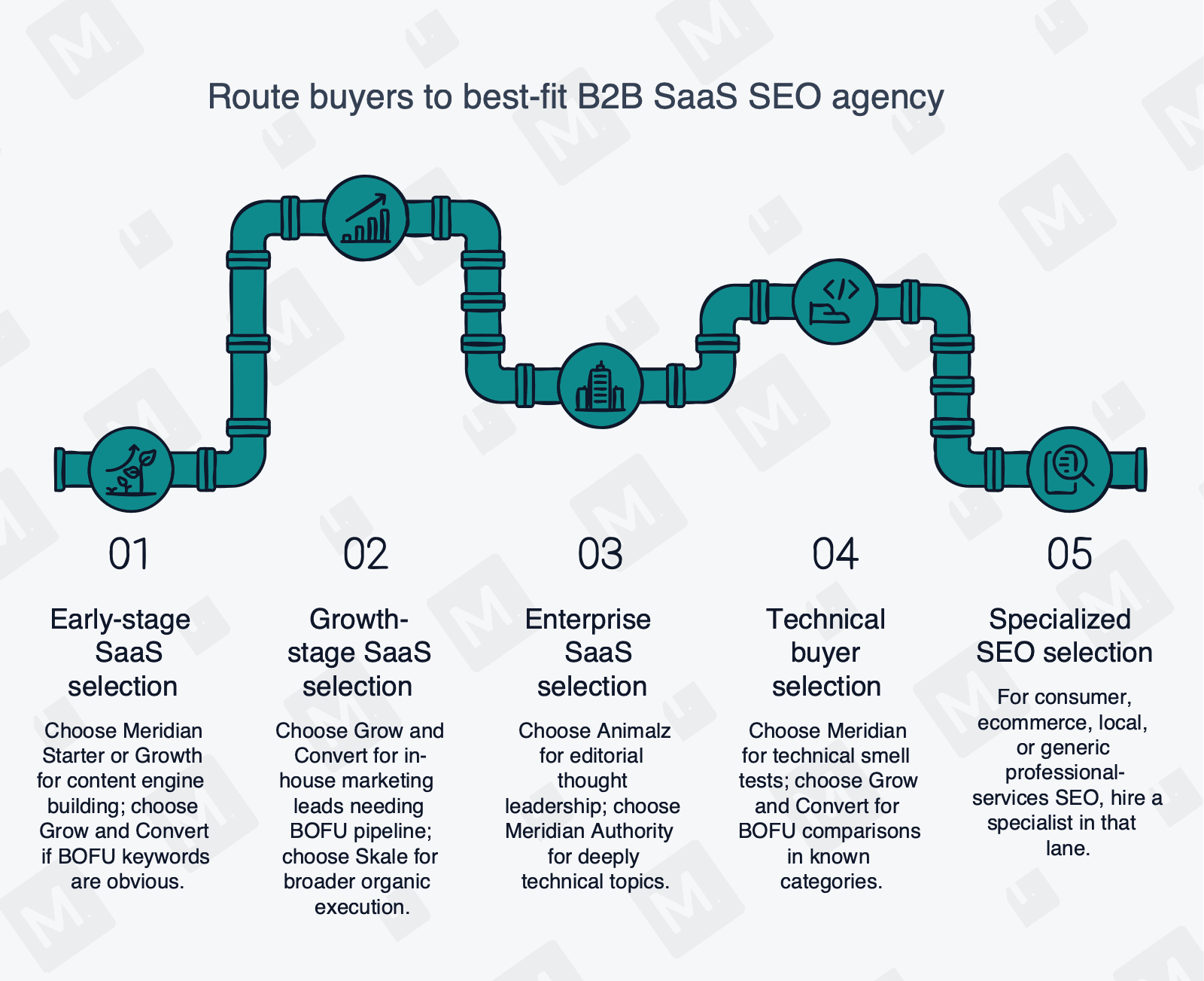
Early-stage technical B2B SaaS building the engine from scratch. Meridian's Starter or Growth tier. The stage rewards published month-to-month pricing over annual commitments, and a technical-B2B production model over generalist writing. Runner-up: Grow and Convert if your BOFU keyword set is already obvious and you can absorb the $9-10K/month figure.
Growth-stage SaaS with an in-house marketing lead who needs BOFU pipeline content. Grow and Convert. The whole model is built for exactly this. You get fewer, deeper, buying-intent posts, and pipeline as the primary metric. Runner-up: Skale (if the in-house lead wants a broader organic execution partner rather than a BOFU-specific one.)
Enterprise B2B wanting editorial thought leadership under named bylines. Animalz. Their editorial staff and cadence — a live Sara Coggin Amplitude case study on the blog as of 2026-07-20 — is the shape you want. Runner-up: Meridian's Authority tier if the topic is deeply technical and named-author authority matters more than an editorial house style.
Developer or security-engineer buyer where a technical smell test matters. Meridian. The founder-review model with a regulated-software background is the sharpest fit for readers who catch wrong sentences. Runner-up: Grow and Convert if the piece is a BOFU comparison in a category their writers already know.
Consumer, ecommerce, local, or generic professional-services SEO. None of these four. This article is explicitly out of scope on those. Do not squint at the profiles and pick the closest fit; closest-fit is how buyers end up unhappy 90 days later.
When the right answer is none of these §
Four honest conditions where none of the four agencies is the right pick.
Budget under $1,500/month. You can't get a full managed engine for that price. A freelance writer in your category plus a strong in-house editor is a higher-yield spend.
Consumer, local, or ecommerce SEO. Different mechanics, different buyer psychology, different keyword architecture. Hire a specialist in that lane instead of forcing a B2B model into a B2C context.
You already have a strong in-house content editor. If you have someone on your team who can edit and make editorial decisions, and give feedback to your writers, it's cheaper to get a boutique agency than a big one.
A one-off product launch, not a content engine. Managed engagements are built for cadence. A single-shot launch page or a one-time whitepaper is a project-based freelance job, not an agency retainer.
How to evaluate any SEO partner §
Four questions to bring to every sales call — Meridian's included. If an agency cannot answer them clearly, that is data.
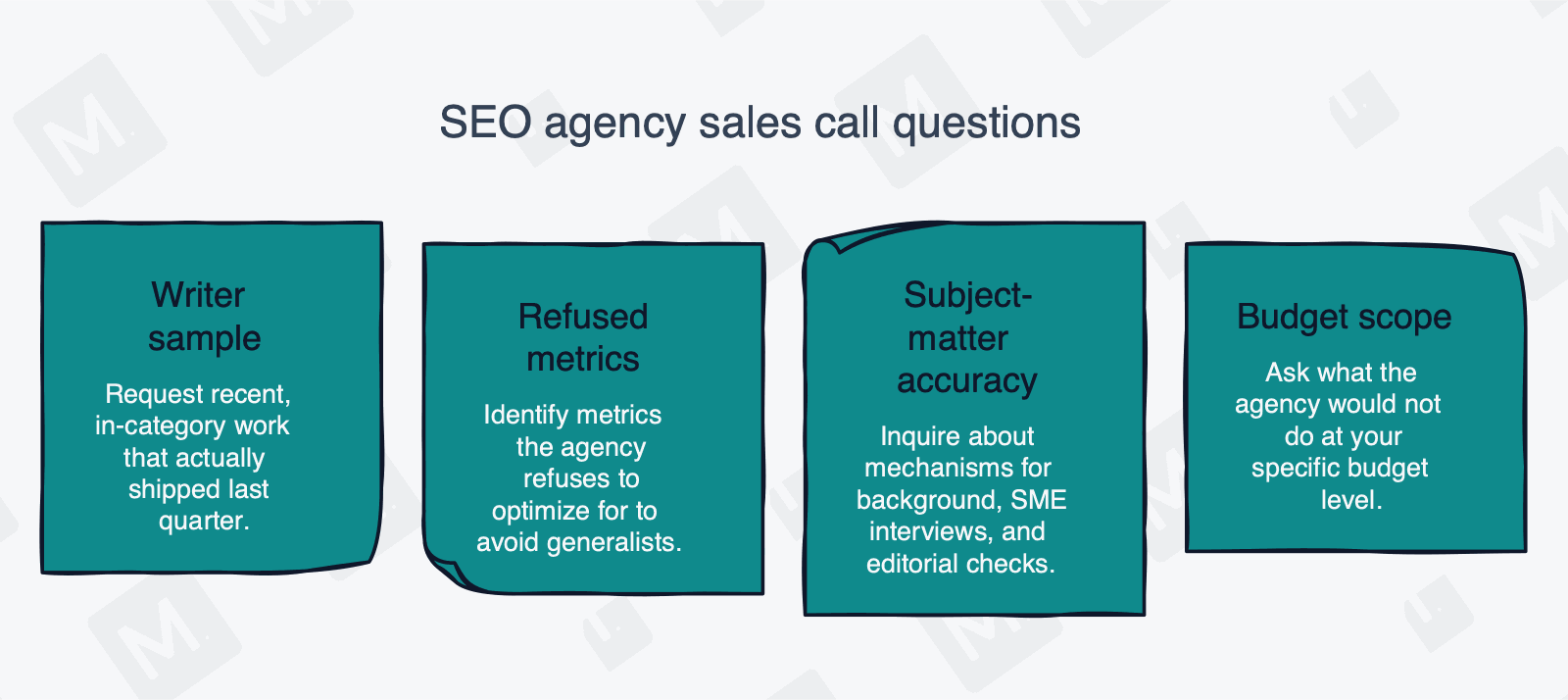
Can I see a writer sample in my category from the last 90 days? Not a pinned case study. Recent, in-category work. Writer quality decays; ask for what actually shipped last quarter.
What metric do you refuse to optimize for, and why? This is the fastest way to catch a generalist. An agency will chase any metric, and once you stop paying them, they will chase someone else's.
How do you handle subject-matter accuracy in technical categories? Ask about the mechanism. With what background? Interviews with what SMEs? Editorial checks at what stage? Vague answers here are almost always vague results.
What would you not do at my budget? Each tier has scope tradeoffs. An agency that claims to do every level well is either overpricing the low end or underdelivering on the high end.
I would rather you use these four questions against Meridian and pass than against Meridian and fail on the sales call. If we can't answer them well, we're not your pick.
Where to go from here §
If Meridian is the right fit for you — tech B2B SaaS at post-Series-A stage, AI search as a default, expert-grade production, pricing quoted month-to-month — reach out to us via seekmeridian.com and tell us what you read above. If not Meridian, one of the other three above is likely the right choice, and the four questions in the section above will help you determine which. The worst case is not choosing the wrong one of us. It's choosing three agencies, all sounding the same, deciding based on who you vibe with, and being unhappy after only 90 days.
FAQ §
Is Animalz still publishing case studies?
The Animalz blog (as of this post's date of 2026-07-20) still has content being written with editorial bylines, including posts by Tim Metz, Ryan Law, Nathan Wahl, Sara Coggin, Ty Magnin, Jimmy Daly, and most recently (as of this post), a case study on how Amplitude grew from 7k to 200k monthly visits with a content engine, the post being titled "7k to 200k Monthly Visits — How Amplitude Built a Content Engine That Scaled From Seed to IPO" by Sara Coggin. So the answer to the FAQ question "Is the blog still posting?" is definitely yes (as of the date of this post).
Is Skale only for B2B SaaS, or do they take consumer clients?
Also, the company Skale is a SaaS organic-growth agency. If you're not a SaaS company, they're not the right agency for you. Jake Stainer's guide to SaaS SEO (as of July 2026) explains it well. Note that this is an SaaS-only agency, so don't expect them to do anything for your consumer or ecommerce GTM. Their authors have written for Typeform, Pitch, Appcues, HotJar, G2, Recruitee, and TravelPerk.
How is Grow and Convert different from a traditional SEO agency?
Traditional agencies focus on keywords and traffic and the "health" of the site (speed, fixing the problems, backlinks, etc.) and Grow and Convert's listicle says if you do this, you're not doing enough SEO, it should be Pain Point SEO with Prioritized GEO first, keywords that are BOFU for when a buyer is about to make a purchase, and then AI search. (Image from Grow and Convert, retrieved July 20, 2026.) Less content, better content, higher prices, stronger attribution, etc.
What does Meridian charge, and how is the engagement structured?
Three tiers, month-to-month, from their homepage (as of 2026-07-20): Starter for $1,500/month (4 articles), Growth for $3,500/month (8 articles, AI Overview and LLM optimization included), and Authority for $5,500/month (12 articles, SME-led authority content and a dedicated strategy owner). No annual commitment. AI-search work is included in Growth and Authority plans across 14 discovery surfaces. Meridian is one of two agencies in this four-agency set that have their pricing visible.
How long until I see results from any of these agencies?
It's really dependent on where you are in the sales cycle and what types of sites you're targeting. Meridian's stats are that the abv.dev example would have been targeted for a $378k pipeline in two months, and another Meridian client doing DevOps work had a $640k pipeline in 12 months (retrieved July 2026, Meridian). Existing authority sites with a lot of content get this bump faster, new sites take longer. Ask for two things when you talk to the agencies about this - first, a comparable stage client's experience, and second, what is the leading indicator for them when they see a move in the pipeline (non-branded impressions, or % of queries that are answerable with AI). If they can't give you a leading indicator, that's a problem. This applies to any b2b saas SEO agency comparison.
Sources §
- https://www.growandconvert.com/seo/best-b2b-saas-seo-agencies/
- https://www.animalz.co/blog/best-aeo-agencies
- https://www.animalz.co/blog/
- https://skale.so/saas-seo/guide/
- https://seekmeridian.com/
- https://seekmeridian.com/about.html
- https://firstpagesage.com/
- https://foundationinc.co/
- https://www.searchenginejournal.com/key-enterprise-seo-and-ai-trends/532337/